
Meeting Times, Location, & Course Delivery Details
Contact Information
Catalog Course Description
This is a dedicated FYE course taught during the first 8-week abbreviated session of fall term. The course will focus on an introduction to Wilmington College, Quakers, adaptation to college life, study skills, introduction to campus services and facilities, and other life skills. This course will also include a unified “summer” reading and additional course materials used to introduce the areas of thought and expression (as well as applied fields) and serve as a first introduction to advising with the creation of a 4-year education plan. Transfer students are not required to take this course.
Course Goals:
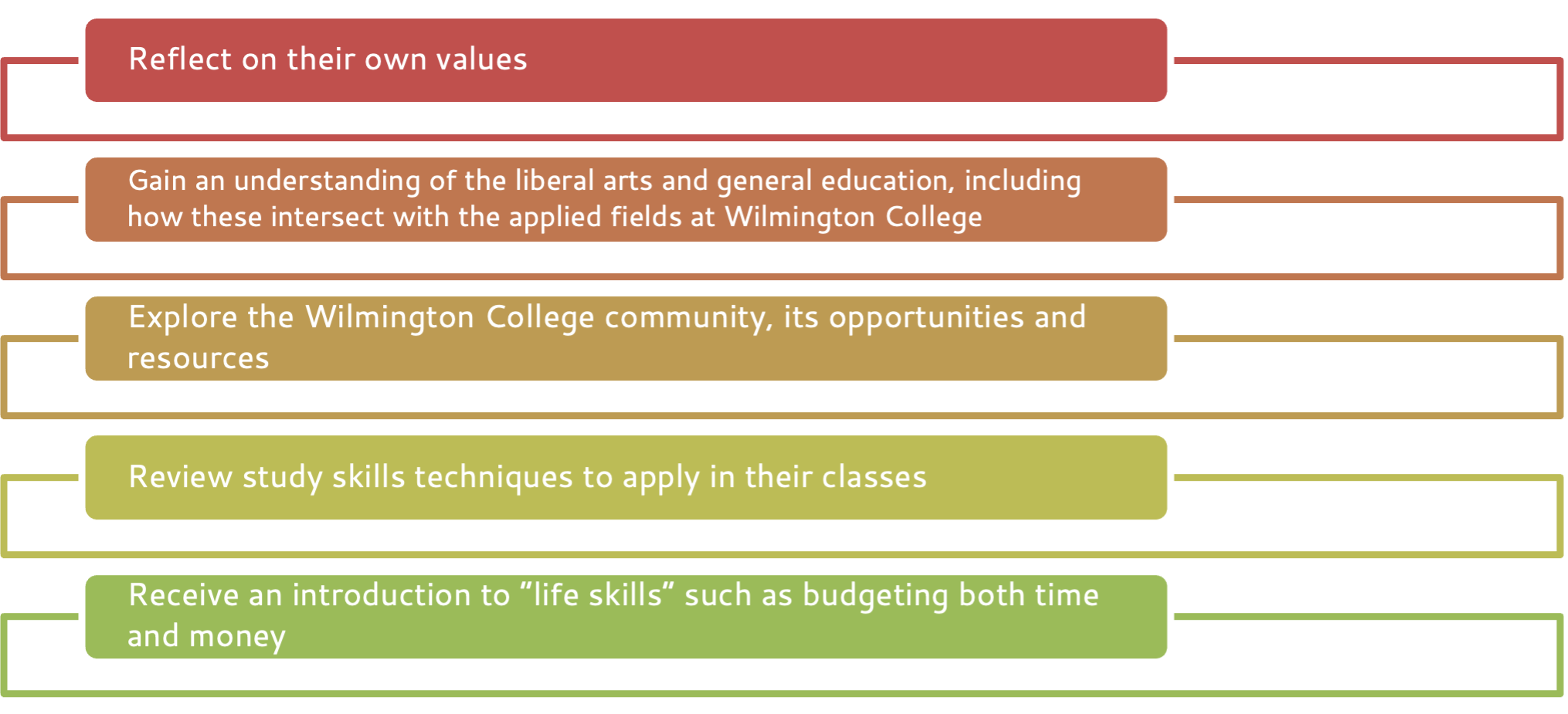
The purpose of this course is to help students adjust to the demands of college courses and various aspects of college life beyond their classroom experience. In addition, students will:

Readings and materials will be made available by the instructor either electronically via Blackboard or in printed handouts.
O’Brien & O’Brien, After Gandhi: One Hundred Years of Nonviolent Resistance, Charlesbridge, 2018.
Course Goals:
The purpose of this course is to help students adjust to the demands of college courses and various aspects of college life beyond their classroom experience. In addition, students will:
Reflect on their own values
Gain an understanding of the liberal arts and general education, including how these intersect with the applied fields at Wilmington College
Tentative Schedule
Subject to change during the semester. Adequate notice of changes will be given.
Date | Topics & Readings | Writing, Quizzes, & Assignments |
F 8/21 | Orientation: Incoming class welcome to FYE Meet with your FYE class | |
WEEK 1 M 8/24
W 8/26
| What is a syllabus? Arriving on Campus – Tip review: People, Places, Patience
|
|
WEEK 2 M 8/31
W 9/2
| Speaker Visit: Jason Dixon
|
|
WEEK 3 M 9/7
W 9/9 | LABOR DAY – no classes
|
|
WEEK 4 M 9/14
W 9/16 | Diversity & Inclusion, Chip Murdock meet in McCoy, Kelly Center
|
|
WEEK 5 M 9/21
W 9/23 |
|
|
WEEK 6 M 9/28
W 9/30 | Academic advising: An introduction to the Liberal Arts & taking inventory, Glossary of academic terms
|
|
WEEK 7 M 9/28
W 9/30 | Art & Nuclear Abolition
|
|
WEEK 8 M 10/5
W 10/7 |
|
|
M 10/12 |
|
Required Assignments
- Special Events (10%):Attendance is required at
- Any campus event (only one may be a sporting event other than your own!): Ice cream socials, Org Fairs, campus speakers
- Any sessions of the Westheimer Peace Symposium
- You must schedule (and attend!) at least one appoint with one of the student support offices on campus
- College Passport (20%): As an incoming student you are required to visit & participate in a minimum number of places/services on campus. You will download the passport Canva slide show from Blackboard—save it on your own device and then visit any 10 of the locations listed. Each location asks for different information and a selfie of you in the space (you may do this with other students!) Turn the completed passport in to your instructor via Blackboard.
- Written Reflections/Self-Navigated Assignment (45%):
- Core Values Reflection
- College & Life Skills: Self-Navigated Assignment & Reflection (2)
- Westheimer Program Summary & Review
- Quizzes (10%): Quizzes are on Blackboard and must be submitted/completed by 9:00 a.m. on Mondays. No late quizzes can be reopened or submitted.
The grading scale will be as follows:
| A = above 93.99% | A- = 93.99 – 91% |
B+ = 90.99 – 88% | B = 87.99 – 84% | B- = 83.99 – 81% |
C+ = 80.99 – 78% | C = 77.99 – 74% | C- = 73.99 – 71% |
D+ = 70.99 – 68% | D = 67.99 – 60.00% |
|
| F = below 60.00% |
|
Instructor Course Policies
Attendance/Engagement is required at all class meetings, special events and activities. You get 2 absence freebies, whatever the reason! (illness, death, relationship drama, POS car, alien abduction…). Because this is an abbreviated course, any absences in excess of 2 will result in automatic failure of the course. Be sure to plan work shifts, medical appointments, family events, and other commitments carefully. If you must be gone, e-mail me as soon as you know you will be absent and understand that you are still responsible for coursework due or covered that day. See current Student Handbook for the college attendance policy especially as it pertains to excused absences.
Academic Integrity: Academic dishonesty in any form will not be tolerated. See the current Student Handbook for the College’s Academic Integrity Policies as they pertain to examinations, plagiarism, classroom behavior, and the process for handling academic misconduct charges. Penalties for plagiarism or cheating in this class may range from an F on the assignment to an F in the class. In addition, all cases will be reported in writing to the Office of Academic Affairs. In the case of serious infractions, the Academic Standards and Appeals Committee may take further action.
Artificial Intelligence: Certain assignments in this course will permit or even encourage the use of generative artificial intelligence (AI) tools, such as ChatGPT. When AI use is permissible, it will be clearly stated in the assignment prompt posted in Blackboard. Otherwise, the default is that use of generative AI is not allowed. In assignments where generative AI tools are allowed, their use must be appropriately acknowledged and cited. For example, if you generated the whole document through ChatGPT and edited it for accuracy, your submitted work would need to include a note such as “I generated this work through Chat GPT and edited the content for accuracy.” Paraphrasing or quoting smaller samples of AI generated content must be appropriately acknowledged and cited, following the guidelines established by the APA Style Guide. It is each student’s responsibility to assess the validity and applicability of any AI output that is submitted. You may not earn full credit if inaccurate on invalid information is found in your work. Deviations from the guidelines above will be considered violations of WC’s academic integrity policy. Note that expectations for “plagiarism, cheating, and acceptable assistance” on student work may vary across your courses and instructors. Please email me or schedule a meeting with me if you have questions regarding what is permissible and not for a particular course or assignment.
Other Considerations and Guidelines:
Communication:
The required method of communication is your Wilmington e-mail account. I expect all e-mails to include a subject line, greeting and salutation. I will afford you the same respect when sending e-mails, encouraging good practice for the professional world. Please proofread your e-mails for spelling and grammatical mistakes and avoid using disrespectful language in them. Violations of these specifications may result in a grade deduction.
Public Communication & ‘Netiquette:
Learning in the “Digital Age” can be both rewarding and challenging. Thus, I’ve provided a few guidelines for classroom conduct that extend beyond our borders, and into the “real” world:
- Students are asked to silence and stow ALL electronic devices during the class period out of respect for the learning environment. Students who lack the maturity and responsibility to fully engage in class cannot fully grasp content. Moreover, this type of behavior suggests that students who cannot engage – nor be productive – for the duration of class periods indicate to others that they are behind in moral and cognitive development. Finally, it is just plain RUDE.
- During class lectures and exercises, students are to use only technology necessary to enhance learning. Any student who actively and disruptively uses media technologies (e.g., a mobile phone for checking Instagram, a laptop for working on other class projects) unless having been asked to do so, or his/her mobile phone (e.g., text messaging, receiving calls, checking Twitter, Snap Chatting) during lectures, exercises, and other students’ presentations will be warned and then asked to leave and not return. Sounds and vibrations coming from electronic devices are distracting to others, and suggest to others that your media devices are more important than personal relationships with your classmates and professors. This includes headphones, Air pods, and any other listening device.
- E-mails to the professor, your classmates, and all other members of the campus community and beyond should include a greeting, cordial and correct language, and a closing. Poor grammar/spelling/mechanics and/or disrespectful e-mails will adversely affect your grade.
- In-class conduct including the use of appropriate language, nonverbal communication, and respect for your professor, and your classmates is also evaluated when calculating your final grade. Thus, behaviors such as (but not limited to) speaking out of turn, carrying on side conversations, using inappropriate eye contact, packing up before class is finished, interrupting a classmate or the professor, working on other assignments, coming to class under the influence of substances, and sleeping, are unacceptable.
Written Assignments Guidelines:
- Both neatness and proper use of English are expected. Each assignment should be carefully proofread so that it is error-free and demonstrates a high level of competence in written communication. Attention should be paid to both form (e.g., grammar, spelling, punctuation, appearance) and content (e.g., clarity, organization, relevance). Excessive errors will reduce your grade. Please note that rubrics will be distributed with your graded papers and are available for your use in preparing your assignments on Blackboard.
- Written work must be typed, double-spaced (please note that the Word default is not consistent with scholarly formatting guidelines, and must be adjusted: see Blackboard for a guide), with one-inch margins, and a 12-point Times New Roman font. You must include: name of course, name of assignment and your name, except for your prospectus, which should include a properly formatted title page. Failure to properly format any assignment will adversely affect your grade.
- Proper citation of sources is important. It should always be clear where in your written assignments you are using the words or the ideas of others, and where these words or ideas are to be found. Papers should be submitted in American Psychological Association (APA) Style if at all possible. See an online APA guide or The Owl at Purdue if you are unsure of how to use proper APA Style. For those majoring in natural sciences or humanities, please come see me about alternative writing styles.