
Meeting Times, Location, & Course Delivery Details
Mode of Delivery
In person:
- The course will be taught in person on Tuesday, Thursday in CSA-310 with lab on Wednesday in RCC-101A
- If you need to attend lectures via Zoom, due to illness or other excused absences, here is the (CSA-310) Zoom link:
- https://wilmington.zoom.us/j/6173935126?pwd=ZWF6Q2FJTDlqankvVWhKc3NKSWErdz09
- meeting ID: 617 393 5126
- passcode: 310620
- If you need to attend labs via Zoom, due to illness or other excused absences, here is Daryl’s Zoom link:
- https://wilmington.zoom.us/j/3722916687?pwd=VWxqTk54UjFxR2dQNERsWmpjU0phdz09
- meeting ID: 372 291 6687
- passcode: 2Ebwzk
- Not all labs will be in RCC-101A and therefore cannot be attended via Zoom. See Daryl if you need to make up one of these labs.
- You must get permission from Daryl before using either Zoom link. Ask for permission as soon as possible if you need to Zoom into class. Email requests made a few minutes before class are unlikely to be responded to and unlikely to receive permission to Zoom
Contact Information
Upon successful completion of this course...
1. The student will be able to describe trends in farm management, management functions & decision
making
2. The student will be able to acquire and organize farm management related information
3. The student will be able to interpret and prepare financial statements, including balance sheet, cash flow,
enterprise budget; income statement, partial budget, and whole-farm plan
4. The student will be able to calculate and interpret measures of efficiency and profitability
5. The student will be able to interpret economic principles related to choosing production levels and
selecting input and output combinations
6. The student will be able to explain principles of land, human resources, and machinery management
7. The student will be able to describe risks inherent in agriculture; interpret risk management tools
8. The student will be able to describe types of farm businesses and guidelines for transfer of the farm
business
9. The student will be able to explain principles and tools related to the use of capital and credit
Required Textbook:
Name: Farm Management
Edition: 10th
ISBN: ISBN: 978-1-264-53264-3 (bound) or 978-1-266-31855-9 (loose-leaf)
Authors: Ronald D. Kay, William M. Edwards, Patricia A. Duffy
Publisher: McGraw-Hill Education
The older 9th edition (ISBN: 978-1-26-000219-5) is acceptable too. Be aware that earlier editions’ chapters may be in a different order than chapters in 9th or 10th editions.
Online Resources:
(links to farm management resources provided by Extension at land-grant universities in Ohio & neighboring states)
https://www.canr.msu.edu/farm_management/
https://farmoffice.osu.edu/farm-management-tools/farm-management-resources
- Describe trends in farm management, management functions & decision making
- Understand how to acquire and organize management related information
- Understand when to use, how to fill out and interpret financial statements, including balance sheet, cash flow, enterprise budget; income statement, partial budget, and whole-farm plan
- Know when to use and how to calculate and interpret measures of efficiency and profitability
- Know when to use and how to interpret economic principles related to choosing production levels and selecting input and output combinations
- Understand principles of land, human resources, and machinery management
- Describe risks inherent in agriculture; interpret risk management tools
- Describe types of farm businesses and guidelines for transfer of the farm business
- Understand principles and tools related to the use of capital and credit
Tentative Schedule for Fall 2026
| Week of: | Lecture Topic(s) | Reading Assignment* |
| August 24 | introduction; farm management trends | Chapter 1 |
| August 31 | management & decision-making | Chapter 2 |
| September 7 | Monday LABOR DAY; getting & organizing information; balance sheet | Chapters 3 & 4 |
| September 14 | income statement; cash flow budgeting | Chapters 5 &13 |
| EXAM #1, Thursday, September 17 | ||
| September 21 | income statement; cash flow budgeting; farm business analysis | Chapters 5, 13 & 6 |
| Tues.-Thur. FARM SCIENCE REVIEW | ||
| September 28 | choosing production levels; choosing input & output combinations | Chapters 7 & 8 |
| October 5 | choosing input & output combos; cost concepts | Chapters 8 & 9 |
| October 12 | enterprise budgeting; whole farm planning; Tuesday FALL FEST | Chapters 10, 11, & 18 |
| October 19 | Monday FALL BREAK; enterprise budgeting; whole farm planning | Chapters 10, 11, & 18 |
| EXAM #2, Thursday, October 22 | ||
| October 26 | partial budgeting | Chapter 12 |
| November 2 | setting price expectations | Chapter 15 |
| November 9 | risk management | Chapter 15 |
| November 16 | land control & use; machinery management | Chapters 20 & 22 |
| EXAM #3, Thursday, November 19 | ||
| November 23 | organize & transfer the business Wed.-Fri. THANKSGIVING BREAK | Chapter 14 |
| November 30 | capital & credit management; | Chapter 19 |
| December 7 | human resource management; Wednesday LAST DAY CLASSES; | Chapter 21 |
| Final Exam, Tuesday, December 15, 1:00 – 3:00 PM (final exams are Fri. Dec. 11, Mon. Dec. 14, Tue. Dec. 15) |
*Additional readings, including handouts, websites, or library resources, may be assigned.
^Same as lecture, reading the textbook, plus any other assigned readings, will help you learn the material in lab.
*Tentative dates for fieldtrips, could be during other lab periods
Grading Activities
| Exams (3 @ 100 points each) | 300 points |
| Quizzes (10 @ 20 points each) | 200 points |
| Attendance* | 100 points |
| Homework & lab assignments (details given at later date)^ | 300 points |
| Final Exam# | 100 points |
| Total | 1000 points |
Weekly Quizzes
- A quiz will be given (possibly on WC Blackboard), unless there is an exam that week
*Attendance
- Attendance is significant. Points for attendance are 10% of the total grade.
- 2.5 points will be earned for each lecture attended.
- 2 points will be earned for each lab attended.
- You must be on time (in classroom by 11:20 AM and lab by 1:00 PM), barring unforeseen circumstances, to receive attendance points each class period. Excused absences (see Attendance Policy) will receive attendance points.
Assignments^
- You will complete homework assignments and laboratory exercises & reports
- Due dates will be given for homework; 1 point will be deducted from a homework grade for each day it is late
- The assignments are significant, they are 30% of the total grade
- Unless otherwise indicated, turn assignments in via Blackboard or cloud-based storage. Do not email assignments.
#Final Exam
- The final exam will be comprehensive
- If you have at least a middle B- average (83.5% or higher) on exams and quizzes combined, AND do not have any unexcused absences, the final exam is optional. Earning a B- (or better) on exams and quizzes combined does not mean you will receive a B- in the class. Your grade can be higher or lower depending on your attendance & homework grades
Grading Policy
From the Wilmington College Faculty Handbook:
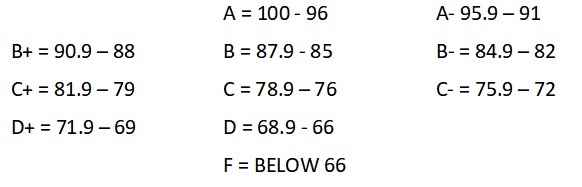
It is the policy of Wilmington College to strive for fairness in grading and avoid grade inflation. Faculty are encouraged to regard "C-" as a satisfactory grade, which means the student is meeting College standards, and will treat it as such in talking with students, unless otherwise noted in the College Catalog. The grade "A", on the other hand, should mean outstanding achievement, with a grade of "B" in between. The grade "D" represents minimally acceptable achievement, and the grade "F" indicates failure.
Instructor Course Policies
- Attendance is required for all class weeks. Students must demonstrate that they are actively participating in the course by submitting required assignments and attending scheduled physical classroom sessions.
- If you are sick or do not feel well, do not come to class if you are sick! Please email the instructor prior to class.
- You are expected to be in class, on time, every time. If you miss more than 3 lectures for reasons other than illness, emergency, or other excused absences approved by the instructor, your total points in the class will be reduced by 5% for each day missed. NO UNEXCUSED ABSENCES FROM LABS
- You are responsible for communicating with the instructor about completing missed work
- The opportunity to makeup missed work may be given only if the absence is excused
- See the current Student Handbook for the College’s Attendance policy especially as it pertains to excused absences.
- If you are absent due to athletics, field trip, or other event where you officially represent the College, please email the instructor at least one week prior to the event. Understand that although these are excused absences, you can only complete missed work IF you let the instructor know ahead of time.
- If absent due to illness or emergency, contact the instructor as soon as you can. If you are absent due to illness, a doctor’s note will make the absence excused and not count as an unexcused absence
- Exams, quizzes, & assignments missed due to unexcused absences will receive a 0 when calculating your final grade
- You are expected to read the assigned material and be prepared for discussion on the material. As a general rule, you should have the reading done for the week at the beginning of the assigned week.
- Wilmington College and federal financial aid authorities require that students commit a minimum of two hours of time per week outside of class for each hour of time they are in class.
- You are responsible for the materials in lecture and in all assigned reading
Academic Integrity
- Absolute honesty is expected. Cheating, plagiarism, lying, or disrespect for other students or the instructor will not be tolerated by the instructor or the College.
- Appropriate Use of Artificial Intelligence:
- Unless given permission by the instructor to use artificial intelligence (AI) apps such as ChatGPT to help you complete an assignment, all work (papers, quizzes & tests, homework assignments, etc.) that you submit in this course must be produced by you and not by AI. Failure to comply with this policy will result in penalties for academic dishonesty (see below).
- IF the instructor gives you permission to use AI and you choose to utilize Chat GPT or another AI platform, screenshot the prompt that you submitted and the response the AI platform gave you. This will allow the instructor to view your input and the AI output to ensure plagiarism was avoided and proper citation was given. Failure to comply with this policy will result in penalties for academic dishonesty (see below).
- Plagiarism will not be tolerated. All references should be provided, if in doubt, provide a reference (this includes works produced with the assistance of AI).
- Academic dishonesty is not acceptable. Assignments, which are plagiarized, will not be accepted and will receive the grade of zero. Cheating on a test or quiz will also receive a grade of zero.
- Penalties for plagiarism or cheating in this class may range from a zero on the assignment to an F in the class. In addition, all cases will be reported in writing to the Office of Academic Affairs. In the case of serious infractions, the Academic Standards and Appeals Committee may take further action.
- “See the current Student Handbook for the college’s Academic Integrity policies as they pertain to examinations, plagiarism, classroom behavior, and the process for handling academic misconduct charges.”
Taking an Online Exam or Quiz:
Cheating is a serious offense and subject to disciplinary action. Some examples of this offense are:
- Any copying or recording of the exam/quiz questions or answers, including taking screenshots, pictures, or video, and disseminating them to anyone before or during the exam.
- Opening browsers and searching for content.
- Using mobile devices/smart phones, other web browsers, software, or other computers during the exam/quiz.
- Bringing in resource materials other than those allowed (e.g., calculator).
- Allowing other individuals to come in and out of the room during the exam.
Plagiarism Policy:
Plagiarism is defined as the representation of another’s words, ideas, concepts, research, or creative production without proper attribution whether intentional or unintentional. It is the student’s responsibility to be informed about what constitutes plagiarism. Plagiarism can occur in the submission of one’s own work or in work submitted by a group.
Examples of plagiarism include the following:
- Paper(s), information, quiz & test answers, homework assignments, etc. created by AI apps such as ChatGPT
- The submission of a paper not one’s own, including turning in a paper that has been purchased from a commercial research firm or obtained from the internet
- Copying word for word information without quotation marks
- Paraphrasing information (that is, the use of one’s own words with only minor changes to the original)
- Use of information not considered general knowledge without proper citation
- Listing of misleading or false sources on a reference page
- The use of a paper or project for one course that was previously submitted for another course, either at Wilmington or at any other institution
Plagiarism is a serious academic offense and carries serious academic consequences. Violations will be recorded by the Associate Vice President of Academic Affairs at the Main Campus and Vice President of External Programs at the Cincinnati Branch Campus.
When an instructor discovers plagiarism, the instructor will first consult with the Associate Vice President of Academic Affairs if a main campus student, or the Vice President for External Programs if a branch campus student, in order to determine if the student is a first-time offender. For first offenses, the instructor has the ability to determine the penalty for the offense. Students with academic integrity violations may not be eligible for academic awards and honors (i.e., Academic Honors, Dean’s List/Merit List, Green Key Honor Society, Quaker Impact Award, and other Honorary Societies). For a second offense or more, the Associate Vice President of Academic Affairs at the Main Campus or the Vice President for External Programs for students at the branch campus, will report the offense to the academic standards and appeal committee and gather evidence for a hearing with the student. It is possible that the student will receive a substantial reduction in grade for the course or will fail the course. Multiple instances could even lead to suspension or expulsion from Wilmington College.
There are many university, college and private websites students may consult about how to avoid plagiarism. Sites with particularly helpful suggestions can be found at:
Electronic Device/Texting Policy
- You need to focus on the materials we are discussing in class. The use of electronic devices is distracting and limits your ability to stay focused in class. Other than a computer you bring to class for taking notes, do not use these devices in class. Also, stay on task with your laptop computer. Do not surf the web, text, etc. when you should be learning the material.
- Repeated violations of this policy may reduce your next grade 10% (e.g., if you earned a 70% on the next exam, your grade would be reduced to 60%)
WC Blackboard
Use (wc.blackboard.com)
- May be used for: quizzes & exams, lecture outlines, assignments, instructions, due dates, readings, posting grades
Help
- If you are having trouble using Blackboard, accessing content, submitting assignments, taking assessments, participating in discussion boards, viewing your grade, or using your technology device, contact the IT helpdesk at helpdesk@wilmington.edu, 937-481-2459, or https://wilmington.freshservice.com/support/home
Communicating with the Instructor
- The best way to reach me is by my College email address: daryl_nash@wilmington.edu
Email & Video Conferencing Etiquette
- When communicating via email, there are some important guidelines to follow:
- Think of your email as a professional, business communication. Include an informative subject line.
- Make sure that your email is grammatically correct. You should think about your email as a chance to show your instructor that you care about the class, and that you are willing to take the time to proofread your message before sending it. Keep your tone friendly and respectful and keep your emails concise and to the point.
Video Conferencing
If you attend class via Zoom, below are a few things to keep in mind:
- Requests to attend class via Zoom for reasons other than illness or emergency must be approved by the instructor at least 1-day in advance. If the reason is due to sudden illness or emergency contact the instructor as soon as you can. Requests will be honored if the reason for attending class fits within the College’s Attendance policy in the Student Handbook (i.e., illness, emergency, approved excused absences). I overslept or do not feel like getting out of bed are not valid reasons for attending class via Zoom.
- Consider your appearance on the webcam. The less seriously you take the video conference, the harder it will be to learn the material or participate in the class.
- Consider what is in the background of your video. Nothing is more embarrassing than an awkward or inappropriate poster or item in your background. A blank background is easiest to work with but be considerate.
- Remember that a video conference has the same degree of respect as a live class. You would not randomly call out or fall asleep during class (let’s hope!), so please continue that respect on the webcam.
- Keep your video on.
- Unless you are speaking keep the mute on. This will avoid background noises.
WC Mission Statement
- The mission of Wilmington College is to educate, inspire and prepare each student for a life of service and success.
- To fulfill that mission, Wilmington College provides a high quality undergraduate and graduate educational environment shaped by the traditions of the liberal arts, career preparation and the distinctive practices of the Religious Society of Friends (Quakers). By offering academic programs, practical experience, and co-curricular activities in a variety of settings to students from diverse backgrounds, the College leads students to gain an awareness of the world, to acquire knowledge of career and vocation and to seek truth and social justice.
- In keeping with the rich heritage of the liberal arts, the College seeks to educate the whole person – intellectual, emotional, physical and spiritual – in ways that foster critical thinking, reflection, the free exchange of ideas, open inquiry, respect for all persons and a desire for lifelong learning. The liberal arts are integrated with career preparation to help students develop the knowledge and skills to succeed in a career or further education.
- As an academic community, Wilmington College is rooted in historic Quaker values, also known as testimonies, which include integrity, service, stewardship, equality, peace and social justice and respect for all persons. These historic testimonies motivate those who learn and work at the College to make positive contributions to their professions and their communities.
Institutional and Program-Level Policies
All exams will follow the Final Exam Schedule. Students scheduled to take three or more final examinations on one day may request to arrange their examination schedule, so no more than two exams occur on one day.
Requests for early or late exams are considered only under extreme circumstances. Prior to the exam period, the student must file a written request on the Early/Late Exam Form available in the Student One Stop Center, Academic Records, and on the WC portal. The form must be signed by the Instructor and the Academic Dean, approving the alternate exam time. This process must be completed prior to the scheduled exam period.
Undergraduate: FA26 Final Exam Schedule
Out-of-class Work Expectation A minimum of 2 hours of out-of-class student work is expected for each hour of in-class time for traditional face-to-face courses. For online and hybrid courses, the combination of face-to-face time and out-of-class work should be equal to 3 hours per credit hour per week. |
Instructional Course Delivery Definition of Courses |
Academic Integrity Policy The use of generative AI is prohibited except where expressly allowed in assignment instructions. Academic Integrity Policy |
Class Attendance Policy Institutional Class Attendance Policy |