
Meeting Times, Location, & Course Delivery Details
Contact Information
Upon successful completion of this course....
Textbook:
Name: Anna Karenina
Edition: Oxford World Classics
ISBN: 978-0198748847
Author: Leo Tolstoy
Publisher: Oxford University Press
Name: Beginning Theory: An Introduction to Literary and Cultural Theory
Edition: 4th
ISBN: 9781526121790
Author: Peter Barry
Publisher: Manchester University Press
To make you an English major with the writing and research skills necessary for graduate school or the workplace, including:
--research skills
--independent long-form writing skills
--knowledge of critical theory
Tentative Schedule
Subject to change during the semester. Adequate notice of changes will be given.
| Week One: | |
| M 8/24: | Introduction to the Course Timeline of literary theory |
| W 8/26: | Leo Tolstoy, Anna Karenina, Part I, Chapter 1-13 |
| F 8/28: | Leo Tolstoy, Anna Karenina, Part 1, Chapters 14-28 |
| Week Two | Liberal Humanism |
| M 8/31: | Tolstoy, Part I, Chapters 29-34 Barry, liberal humanism, p. 1-7, 11-20 |
| W 9/2: | Tolstoy, Part II, Chapters 1-14 |
| F 9/1: | Tolstoy, Part II, Chapters 15-28 In-class short essay due |
| Week Three: | Structuralism |
| M 9/7: | Labor Day: No class |
| W 9/9: | Tolstoy, Part II, Chapter 28-Part III, Chapter 4 Barry on Structuralism, p. 41-60 |
| F 9/11: | Tolstoy, Part III, Chapter 5-17 Handout: Viviane Serfaty, “Online Diaries : Towards a Structural Approach,” Journal of American Studies 38.3 (2004): 457-71. In-class short essay Due |
| Week Four: | Post-structuralism and Postmodernism |
| M 9/14: | Tolstoy, Part III, Ch 18-22 Barry on Post-structuralism and postmodernism p. 60-95 |
| W 9/16: | Tolstoy, Part III, Ch 23-Part IV, Ch 3 |
| F 9/18: | Tolstoy, Part IV, Chapters 4-16 In-class short essay due |
| Week Five | Psychoanalysis |
| M 9/21: | Tolstoy, Part IV, Chapters 17-23 Barry on psychoanalytic criticism, p. 97-120 |
| W 9/23: | Tolstoy, Part V, Chapters 1-14 |
| F 9/25: | Tolstoy, Part V, Chapters 15-27 In-class short essay due |
| Week Six | Feminism |
| M 9/28: | Tolstoy, Part V, Chapters 28-33 Barry on feminist criticism, p. 123-138 |
| W 9/30: | Tolstoy, Part VI, Chapters 1-12 |
| F 10/2: | Tolstoy, Part VI, Chapters 13-23 In-class short essay due |
| Week Seven | Marxism |
| M 10/5 | Tolstoy, Part VI, Chapters 24- 32 Barry on Marxist criticism, p. 159-174 |
| W 10/7: | Tolstoy, Part VII, Chapters 1-14 |
| F 10/9: | Tolstoy, Part VII, Chapters 15-28 |
| Week Eight: | New Historicism |
| M 10/12: | Tolstoy, Part VII, Chapters 29-Part VIII, Chapters 1-6 Barry on New Historicism, p. 175-193 |
| W 10/14: | Tolstoy, Part VIII, Chapters 7-end |
| R 10/13 | Handout: Alexander Burry, “The Railway and the Elemental Force: Slavophilism, Pan-Slavism, and Apocalyptic Anxieties in Anna Karenina,” Russian Writers and the Fin de Siecle: The Twilight of Realism. Databases: Julie W. de Sherbinin, “The Dismantling of Hierarchy and the Defense of Social Class in Anna Karenina,” Russian Review 70.4: 646-662. |
| Week Nine | Postcolonial Criticism |
| M 10/19: | Fall Break—No Class |
| W 10/21: | Essay #1 First Draft Due |
| F 10/23: | Barry on Postcolonial criticism, p. 194-201 Handout: Tatiana Kuzmic, “‘Serbia: Vronskii’s Last Love’: Reading Anna Karenina in the Context of Empire,” Toronto Slavic Quarterly 43 (Winter 2013). |
Week Ten | Environmental Theory |
| M 10/26: | Handout: Anna Primrose Bendiksen, “The Swishing of the Scythes: The Mowing Scene in Anna Karenina” Russian Literature 40.4 (1996): 517-524. |
| W 10/28: | Essay #1 Final Draft Due Library day |
| R 10/30: | Individual Conferences |
| Week Eleven: | Queer Theory |
| M 11/2: | Library day #2 |
| W 11/4 | Barry on Queer Theory, p. 141-156 Elizabeth Blake, “Toward a Happy Marriage: Transcending Gendered Social Roles in Anna Karenina,” Studies in Slavic Cultures 2 (January 2001). Working thesis due |
| F 11/6: | Introduction, Outline, and Preliminary Bibliography of Senior Seminar Paper Due |
| Week Twelve | |
| M 11/9: | Visit from English Faculty |
| W 11/11 | Review/workshopping |
| F 11/13: | Literary theory exam |
| Week Thirteen: | |
| M 11/16: | Draft #1 (partial) of Senior Seminar Paper Due |
| W 11/18: | Annotated Bibliography Due Dinner at Ursula’s house |
| F 11/20: | Draft workshopping |
| Week Fourteen: | |
| M 11/23: | Draft #2 (full) of Senior Seminar Paper Due |
| W 11/25: | Thanksgiving break: No Class |
| F 11/27: | Thanksgiving break: No Class |
| Week Fifteen: | |
| M 11/30: | |
| W 12/2 | Draft #3 of Senior Seminar Paper Due |
| F 12/4 | Poster drafts due |
| Week Sixteen | |
| M 12/7 | Final presentation rehearsals |
| W 12/9: | Final draft of Senior seminar papers due
|
| FINAL PRESENTATIONS: Friday, December 11: 8-10 am | |
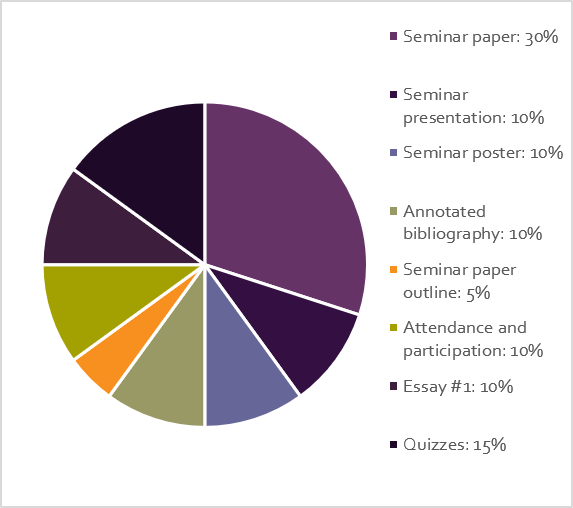
- Weekly in-class short essays: 1 page commentary on our readings.
- Essay #1: A short (3-4 page) literary analysis of our text.
- Annotated bibliography: A collection of sources for your larger research project, with summaries.
- Seminar paper: A 15-20 page research project either on Anna Karenina or a text you choose in consultation with me.
- Seminar presentation: A 10-minute oral presentation of your research to the class, fellow English majors, and English faculty.
- Seminar poster: A visual representation of your argument, created with a PowerPoint template (or your own creativity!).
- Quizzes: Reading quizzes and a short exam over literary theory concepts.
- Drafts, outlines, and prep material for your seminar paper.
The grading scale will be as follows:
Grades will be posted on Blackboard regularly. 93%-100% is an A, 90-93% is an A-, 87-90% is a B+, etc. You must receive at least a C- to pass the Senior Seminar requirement for the English major.
Instructor Course Policies
Guideline for Attendance Grades
- 8 or more absences: F
- 7 absences: D
- 5-6 absences: C
- 4 absences: B
- 3 or fewer absences: A
What do I do if I have to be absent?
- Talk to me as soon as possible about the absence
- Make up the work as soon as possible
- Get notes from a classmate
Excused vs. unexcused absences
Being in class is important to learning, and if you miss class, you will miss learning, no matter the reason you have missed class. I will work with you on emergency situations, but please prioritize attendance and understand that even absences for sports, other college events, or illness that go beyond the one week of permitted absences will generally affect your grade.
See the current Student Handbook for the college’s Academic Integrity policies as they pertain to examinations, plagiarism, classroom behaviour, and the process for handling academic misconduct charges. You may not copy the words or ideas of another without crediting that person in your text. This includes paraphrasing material or maintaining the same general sentence or paragraph structure as a source. Even credited material must be paraphrased in an original way that generates a new sentence and paragraph structure. Keep in mind that even unintentional copying of words, phrases, and sentence structures can sometimes be deemed plagiarism. I should always know, when reading a paper, which ideas, words, phrases, and paragraph structures originate with you and which originate with someone else. If I find that you have committed academic dishonesty on an assignment for this course, you will receive a zero for the assignment and, depending on the offense, you may receive an F for the course. In general, all offenses, minor and major, will be reported to the Associate Vice President of Academic Affairs, who will help me determine the appropriate consequences. If you have questions about what constitutes plagiarism, ask!
Any work that you produce in this class must be original and created by you, not by artificial intelligence (i.e., ChatGPT or other AI bots). I do not allow AI on any stage of the writing process in this class, including brainstorming, drafting, revision, grammar checks, or citation. The goal in this class is not to do all of those things perfectly but to learn how to do them together. If I believe that your work reflects AI usage, I will ask you to re-do the assignment, and if the problem persists, you will receive a zero on the assignment and a report in your file with Academic Affairs.
Institutional and Program-Level Policies
All exams will follow the Final Exam Schedule. Students scheduled to take three or more final examinations on one day may request to arrange their examination schedule, so no more than two exams occur on one day.
Requests for early or late exams are considered only under extreme circumstances. Prior to the exam period, the student must file a written request on the Early/Late Exam Form available in the Student One Stop Center, Academic Records, and on the WC portal. The form must be signed by the Instructor and the Academic Dean, approving the alternate exam time. This process must be completed prior to the scheduled exam period.
Undergraduate: FA26 Final Exam Schedule
Out-of-class Work Expectation A minimum of 2 hours of out-of-class student work is expected for each hour of in-class time for traditional face-to-face courses. For online and hybrid courses, the combination of face-to-face time and out-of-class work should be equal to 3 hours per credit hour per week. |
Instructional Course Delivery Definition of Courses |
Academic Integrity Policy The use of generative AI is prohibited except where expressly allowed in assignment instructions. Academic Integrity Policy |
Class Attendance Policy Institutional Class Attendance Policy |